
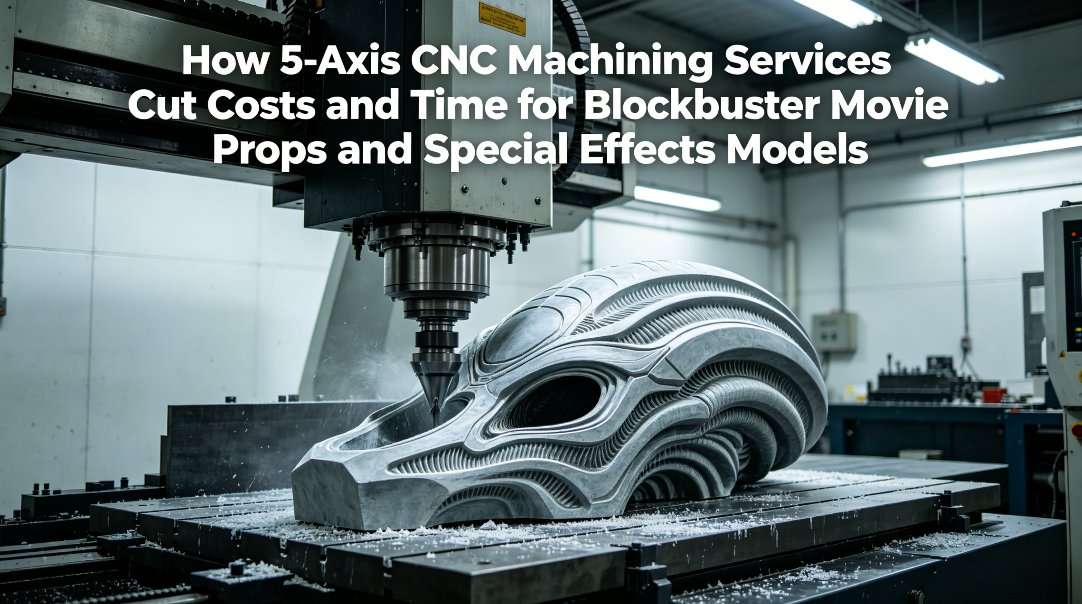
How 5-Axis CNC Machining Services Cut Costs and Time for Blockbuster Movie Props and Special Effects Models
Introduction
Film production — especially in sci-fi, fantasy, and historical genres — demands generous highly customized, structurally complex physical props, miniature models, and special effects devices. Traditional handcrafting or simple machine tools often struggle with extremely intricate geometries, strict dimensional accuracy, and compressed production schedules, leading to cost overruns, delivery delays, and compromised final visuals.
The root cause lies in the inherent limitations of conventional methods: difficulty achieving design freedom, inability to machine complex features in a single setup, and slow iteration cycles. Multiple setups and manual assembly introduce errors and consume precious time. This article explores how 5-axis CNC machining has become a game-changer for the film industry. By seamlessly translating digital models into high-precision physical components, this technology optimizes both budgets and timelines while delivering exceptional on-screen quality.
Why Do Complex Movie Props Demand Beyond 3-Axis Machining?
Movie props — such as weapons with organic curves, armor with deep undercuts, creature models, and architectural miniatures — require manufacturing capabilities far beyond what 3-axis CNC can offer. Complex part machining for film demands single-setup completion of multi-sided features, which 3-axis machines cannot achieve without costly repositioning and error accumulation.
- The Limitations of 3-Axis for Cinematic Detail: 3-axis CNC machining relies on linear movements along X, Y, and Z axes. For a prop requiring features on multiple faces — like a sci-fi rifle with contours on all sides — the workpiece must be manually repositioned several times. Each repositioning introduces alignment errors that accumulate across the part. Furthermore, deep cavities and angled features are inaccessible, forcing designers to split components into multiple pieces for later assembly, which compromises structural integrity and adds labor hours.
- The Freedom of 5-Axis Single-Setup Machining: 5-axis CNC adds two rotational axes, allowing the cutting tool to approach the workpiece from virtually any direction. This enables single-setup machining of even the most complex geometries. A hero prop that would require five or six setups on a 3-axis machine can be completed in one uninterrupted cycle. This eliminates cumulative errors, reduces handling time, and preserves the dimensional fidelity required for close-up shots. The result is a part that matches the digital model with micron-level precision.
- Meeting the Visual Standards of Modern Cinema: Modern audiences expect flawless realism in every frame. Props and models are scrutinized in high-definition close-ups, where any imperfection — a mismatched seam, a visible tool mark, an asymmetric contour — becomes glaringly obvious. Adherence to rigorous standards like ASME Y14.5 for geometric dimensioning and tolerancing ensures that every feature conforms to the design intent. This level of precision 5-axis machining is essential for creating screen-ready components that withstand the unforgiving lens of a camera.
How Can 5-Axis CNC Services Streamline Prototyping for Film Production?
In film pre-production, rapid prototyping is critical for visualizing concepts, testing mechanical functions, and fitting actors. CNC machining service providers using 5-axis technology can produce high-fidelity prototypes directly from CAD data, offering advantages in material strength, surface quality, and accuracy over 3D-printed alternatives.
1. From Digital Concept to Physical Reality
When a concept artist finalizes a 3D model, the clock starts ticking. 5-axis CNC can transform that digital file into a machined prototype in days, not weeks. This allows the production team to hold, test, and evaluate the prop in real-world conditions. Benefits of 5-axis CNC include the ability to machine prototypes from the same production-grade materials — aluminum, engineering plastics, or composites — that will be used in the final hero prop, providing an accurate representation of weight, balance, and durability.
2. Early Detection of Design Issues
A physical prototype reveals problems that a screen render cannot: ergonomic discomfort, clearance interference with an actor’s costume, or structural weakness under stress. By producing a functional prototype early, the design team can iterate and refine before committing to final production. This early problem-solving prevents costly rework during the high-pressure shooting schedule. For teams wanting a deeper understanding of how this technology works, a detailed guide on 5-axis CNC machining services covers the full scope of capabilities available for entertainment projects.
3. Superior Surface Finish and Detail Resolution
While 3D printing is fast, it often leaves layer lines and a porous surface that requires extensive post-processing. 5-axis CNC machining produces parts with smooth, isotropic surfaces directly from the machine. Fine details — engraved text, intricate panel lines, textured grips — are rendered with exceptional clarity. This reduces the time and cost of finishing work, getting the prop ready for paint and weathering sooner.
What Are the Key Considerations for a 5-Axis CNC Machining Quote in Entertainment?
Obtaining an accurate 5-axis CNC machining quote for film props requires understanding the factors that drive cost. Unlike standard industrial parts, movie props often involve unique geometries, specialized materials, and demanding surface finishes. A structured approach to defining requirements ensures predictable budgeting and avoids surprises.
1. Geometry Complexity and Feature Density
The most significant cost driver is part complexity. A prop with numerous free-form surfaces, deep pockets, thin walls, and tight internal corners requires more programming time, longer machining cycles, and specialized tooling. Providing a clean, watertight 3D CAD model (STEP or IGES format) allows the manufacturer to analyze the geometry and estimate machining time accurately. Simplifying non-critical features can reduce cost without affecting the on-screen appearance.
2. Material Selection and Surface Finish Requirements
The choice of material directly impacts both CNC machining service cost and performance. Aluminum alloys (6061, 7075) offer a balance of weight, strength, and machinability for hero props. Engineering plastics like PEEK or Delrin provide durability for stunt doubles. Brass or stainless steel add heft for period weapons. Surface finish specifications — whether the part needs a mirror polish for reflective armor or a textured finish for weathered props — also affect cycle time and post-processing costs.
3. Quantity, Lead Time, and Post-Processing
Whether the project requires a single hero prop, a set of matching stunt doubles, or a dozen background pieces influences the per-unit cost. Batch economies apply even in low volumes. Urgent lead times may require expedited scheduling, adding a premium. Finally, post-processing — painting, weathering, electroplating, or assembly — should be specified upfront. The most direct way to obtain an optimized quote for entertainment projects is to consult an experienced 5-axis CNC machining services factory that understands the unique demands of film production.
How Does a Reliable 5-Axis CNC Supplier Ensure Quality for On-Screen Components?
Quality in film prop manufacturing is non-negotiable. A 5-axis CNC supplier must demonstrate systematic quality assurance through certified management systems, rigorous inspection protocols, and proactive engineering collaboration. These systems ensure that every component meets the exacting standards of on-screen performance.
1. The Role of Certified Quality Management Systems
International certifications provide independent verification of a supplier’s quality infrastructure. ISO 9001 establishes a foundational framework for process control, documentation, and continuous improvement. For projects requiring extreme reliability, IATF 16949 (automotive) and AS9100D (aerospace) certifications impose even stricter requirements for risk management, traceability, and change control. As the International Organization for Standardization (ISO) emphasizes, these standards help organizations consistently deliver products that meet customer and regulatory requirements. A manufacturer holding multiple certifications demonstrates a proven commitment to quality across diverse industries.
2. Design for Manufacturability (DFM) and First Article Inspection
Before any cutting begins, a thorough Design for Manufacturability (DFM) review identifies potential issues with the design — thin walls, sharp corners, or inaccessible features — and suggests modifications that improve reliability without compromising aesthetics. After machining, a First Article Inspection (FAI) using coordinate measuring machines (CMMs) verifies every critical dimension against the CAD model. This documented validation ensures the part is correct before proceeding to finishing or duplication.
3. Traceability and Documentation for Creative Teams
A reliable Custom CNC Parts Manufacturer provides full traceability for every component. Material certifications, inspection reports, and process records are archived and available upon request. For production teams managing complex prop inventories, this documentation ensures that replacement parts can be manufactured identically, maintaining visual consistency across reshoots or sequels.
What Are the Long-Term Benefits of Partnering with a Precision Machining Expert for Film Projects?
Beyond individual projects, establishing a relationship with a precision 5-axis machining partner creates strategic value for film studios and effects houses. This partnership builds a reliable manufacturing supply chain, accumulates reusable process knowledge, and enables increasingly ambitious creative visions.
- Building a Reliable Manufacturing Supply Chain: A trusted machining partner becomes an extension of the production team. They understand the studio’s quality expectations, communication preferences, and urgency requirements. Over multiple projects, they develop institutional knowledge about material behaviors, finishing techniques, and design best practices specific to film applications. This continuity reduces ramp-up time for new projects and minimizes the risk of miscommunication.
- Accumulating Reusable Process Knowledge: Each project generates valuable data: optimal toolpaths for specific geometries, fixturing strategies for delicate parts, and finishing recipes for consistent appearance. A long-term partner archives this knowledge, making it available for future projects. When a sequel requires a redesigned version of a previous prop, the manufacturer can reference the original process, accelerating development and ensuring visual consistency.
- Enabling Greater Creative Ambition: When directors and production designers know that advanced manufacturing capabilities are available, they can push creative boundaries with confidence. Complex mechanisms, intricate lattice structures, and seamless multi-material assemblies become feasible. The partnership transforms manufacturing from a constraint into an enabler of creativity, allowing filmmakers to realize visions that would have been impractical or impossible with traditional methods. For studios planning their next groundbreaking project, contacting a precision machining expert for a contact for CNC quote and technical consultation is the first step toward turning ambitious concepts into screen-ready reality.
Conclusion
5-axis CNC machining technology is reshaping the craft of physical effects and prop fabrication for the film industry. Its unmatched geometric freedom, exceptional precision, and predictable delivery cycles bring imaginative designs from the digital realm into physical existence with remarkable fidelity. At the same time, it provides critical control over tightly constrained production budgets and schedules. For modern film projects pursuing the highest visual quality and production efficiency, understanding and leveraging this technology has become a significant competitive advantage.
FAQs
Q: Can 5-axis CNC machining handle the delicate details required for close-up shots in movies?
A: Absolutely. High-precision 5-axis systems achieve tolerances as tight as ±0.005 mm and superior surface finishes directly from the machine. This is crucial for props scrutinized in HD close-ups, ensuring every engineered detail appears crisp and intentional on screen.
Q: How does the cost of 5-axis CNC for a one-off custom prop compare to traditional sculpting methods?
A: For complex geometries, 5-axis CNC can be cost-competitive or more economical. While machine rates are higher, it drastically reduces manual labor, minimizes material waste, and slashes iteration time. The cumulative cost of skilled artisans over longer durations often exceeds streamlined digital manufacturing.
Q: What file format is best to provide for a 5-axis CNC machining quote for a movie prop?
A: A 3D CAD model in STEP or IGES format is essential, accurately representing the final geometry. Accompanying 2D drawings with critical dimensions, tolerances (per ASME Y14.5), and surface finish specifications enable the most accurate and comprehensive quote.
Q: Are the materials used in 5-axis CNC machining durable enough for active use as functional props on set?
A: Yes. 5-axis machines a vast range of production-grade materials. For functional props needing lightweight strength, aluminum alloys or high-strength polymers like PEEK are excellent. For metallic heft, stainless steel or brass can be used. The manufacturer advises on optimal material selection.
Q: How can a production ensure the intellectual property (IP) of a unique prop design is protected when outsourcing CNC machining?
A: Reputable suppliers prioritize confidentiality through strict NDAs, secure IT systems, and controlled physical access. Choosing an ISO 9001-certified supplier ensures documented procedures for handling confidential information are in place, providing strong IP protection.
Author Bio
The insights in this article are contributed by a precision manufacturing specialist with over a decade of experience delivering complex custom components across multiple industries. The author’s team is dedicated to helping clients transform creative concepts into physical reality through advanced manufacturing technologies. For film producers, prop masters, and effects studios planning their next ambitious project, consulting with a precision machining expert is the first step toward success. LS Manufacturing provides advanced 5-axis CNC solutions backed by ISO 9001, IATF 16949, and AS9100D certifications, ready to support your most demanding creative visions.


